

How to Verify Fastener Quality from Chinese Suppliers: A Buyer’s Checklist
A practical 7-point checklist to verify fastener quality from Chinese suppliers before placing your first order.
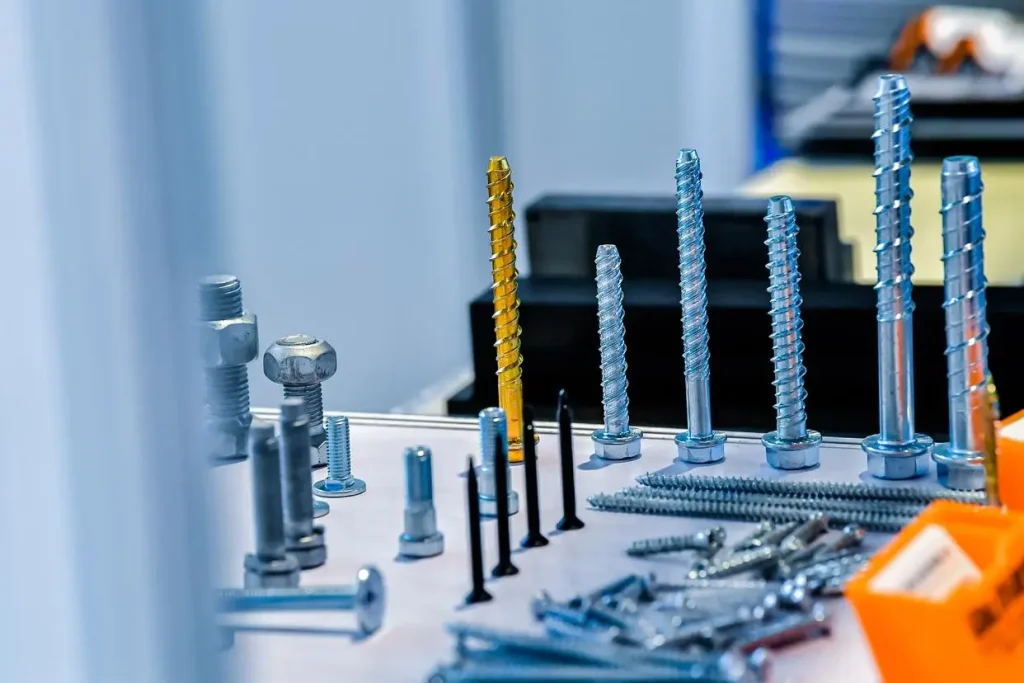
A single failed bolt in a structural connection can cost millions in downtime—or worse, lives. Yet every week, procurement managers around the world receive container loads of fasteners from China that look fine on the outside but fail catastrophically under load. The problem isn’t that Chinese manufacturers can’t produce quality fasteners. The problem is knowing how to separate the reliable suppliers from the ones who will cut corners the moment your purchase order is signed.
At Mertra, we have spent over a decade manufacturing and exporting ASTM, DIN, and ISO standard bolts, nuts, and washers to clients in North America, Europe, the Middle East, and Southeast Asia. We have seen the good, the bad, and the dangerous. This guide is written from that insider perspective to give you a practical, seven-point checklist you can use before you wire a single dollar.
Why Quality Verification Matters More Than Price
Fasteners are not commodities. A Grade 8.8 bolt and a bolt that merely has “8.8” stamped on its head are two completely different products. We once received a distressed inquiry from a German distributor who had sourced 50,000 pieces of supposedly DIN 933 hex bolts from a low-cost supplier in Hebei. The bolts looked perfect—zinc-plated, cleanly threaded, correct head markings. But when their lab tested a random sample, the tensile strength was only 620 MPa instead of the required 800 MPa. The material was plain low-carbon steel, not the quenched-and-tempered medium-carbon steel required by ISO 898-1. The entire batch had to be scrapped, costing them €40,000 and a major construction delay.
This story is not unique. It happens because many small trading companies in China pose as manufacturers, subcontract production to the cheapest workshop they can find, and rely on the fact that most overseas buyers never perform incoming inspection. The good news is that these risks are entirely avoidable if you know what to check.
The 7-Point Quality Verification Checklist
1. Check Factory Certifications—But Do Not Stop There
ISO 9001 is the baseline, not a guarantee. Any serious fastener manufacturer should have a valid ISO 9001 certificate, but in China, certificates can be bought, photocopied, or simply faked. Here is what to do:
- Ask for the certificate number and verify it on the certification body’s website (SGS, TÜV, BV, or CNAS-accredited agencies).
- Check the scope of certification. A certificate that only covers “trading” or “sales” means they are not manufacturing anything themselves.
- Look for industry-specific certifications. If you are buying structural bolts, ask for ASTM F606 test capability. If you are buying automotive fasteners, IATF 16949 is highly relevant. If the supplier claims to make Grade 12.9 socket head cap screws but has no metallurgical lab, that is a red flag.
- Request a business license and export license. Cross-check the registered address with the factory address they give you. If they are different, you are likely talking to a trading company.
At Mertra, we maintain ISO 9001 certification with a scope covering “manufacturing of high-strength bolts, nuts, and threaded rods,” and we welcome clients to verify our certificate directly with TÜV Rheinland.
2. Request Material Test Certificates (MTC) for Every Batch
A Material Test Certificate is the birth certificate of your fasteners. It should contain:
- Heat number (furnace batch number) that matches the marking on the fasteners
- Chemical composition (C, Mn, Si, Cr, Ni, Mo, etc.) compared against the standard
- Mechanical properties: tensile strength, yield strength, elongation, and reduction of area
- Hardness values (HV, HB, or HRC depending on the standard)
For example, a genuine MTC for ASTM A325 structural bolts should show:
- Tensile strength ≥ 120 ksi (827 MPa)
- Yield strength ≥ 92 ksi (634 MPa)
- Elongation ≥ 14%
- Hardness HRC 19–30
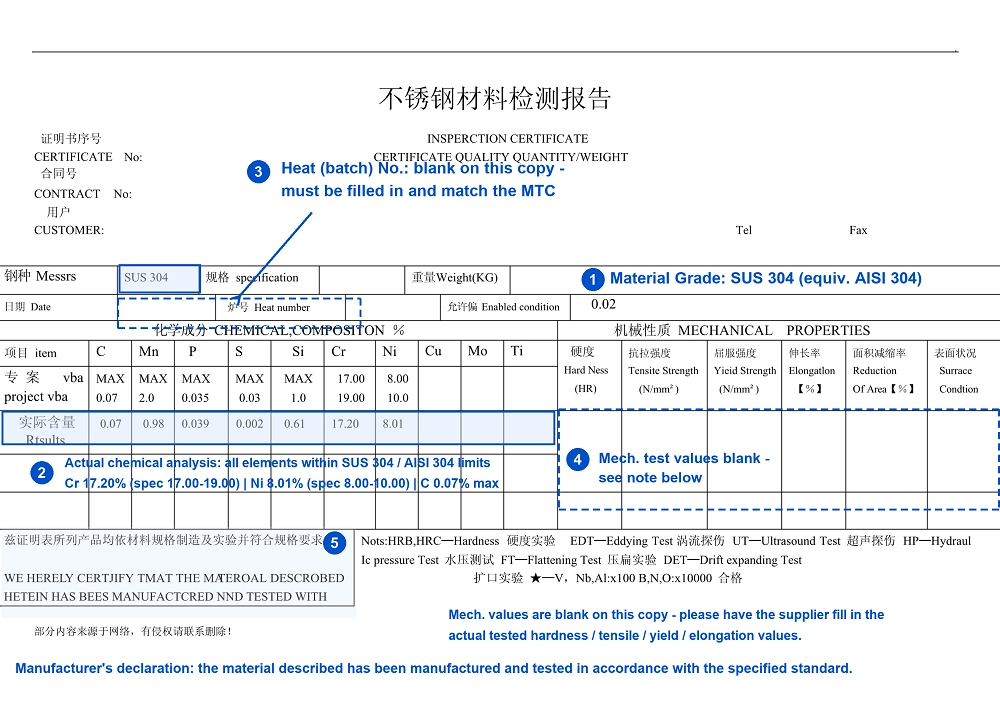
Red flags to watch for:
- Generic MTCs with no heat number or batch reference
- MTCs that look like Word templates (easily editable)
- Mechanical values that are suspiciously uniform across multiple batches
- Missing third-party lab stamp or signature
We provide original MTCs with every shipment, and we keep retained samples from each heat batch for 24 months so we can re-test if any dispute arises.
3. Demand Pre-Production Samples and Test Them Properly
Never place a bulk order based on photos and promises alone. A professional supplier should provide samples within 7–10 days. Here is how to evaluate them: Dimensional inspection:
- Use a thread gauge (go/no-go) to check thread accuracy
- Measure head height, width across flats, and body diameter with calipers
- For structural bolts, check thread length against the standard (e.g., ASTM A325 requires 2D + 1/4″ minimum thread length for bolts ≤ 4D in length)
Mechanical testing (send to your local lab or a third-party lab in China)
- Tensile test per ASTM F606 or ISO 898-1
- Wedge tensile test (for structural bolts)
- Hardness test (Rockwell C for high-strength bolts)
- For stainless steel fasteners, request a PMI (Positive Material Identification) test to confirm the grade is actually 304 or 316
Surface and coating inspection:
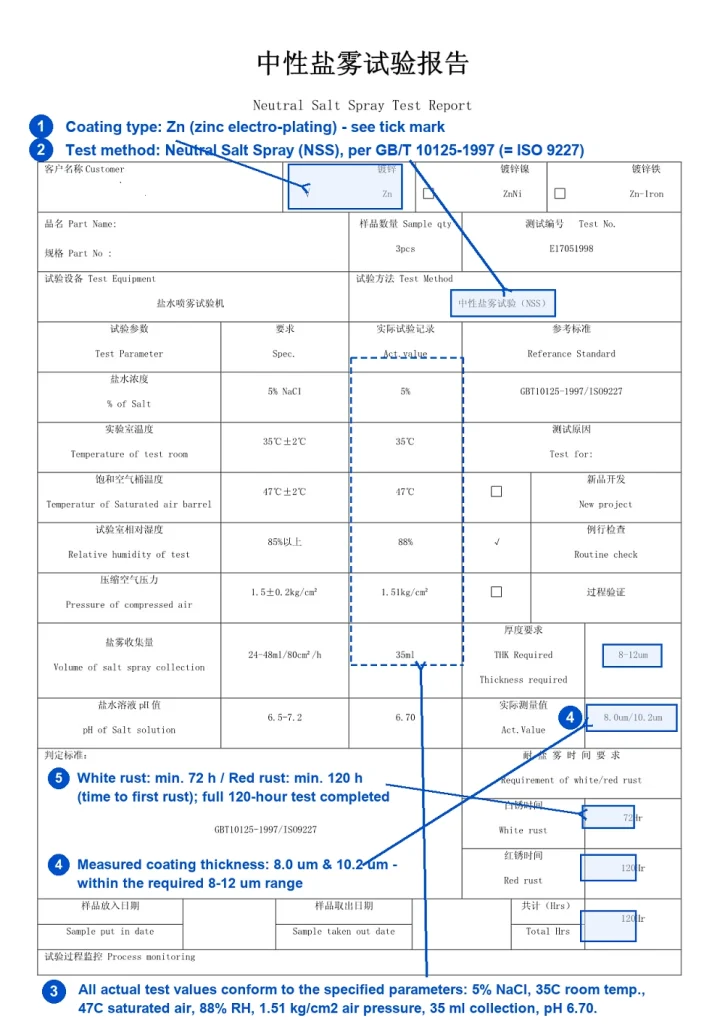
- Coating thickness gauge for zinc-plated or hot-dip galvanized bolts
- Salt spray test report if corrosion resistance is critical (e.g., 500 hours for Dacromet coating)
- Visual inspection for cracks, burrs, or incomplete threads
Keep the approved sample sealed and labeled. When the bulk shipment arrives, compare it directly against this master sample.
4.Verify Production Equipment and In-House Testing Capability
A real fastener factory will have invested heavily in specialized equipment. During a video factory audit (or in-person visit), look for:
Forming equipment:
- Multi-station cold forging machines (brands like Nedschroef, Sakamura, or high-quality Chinese equivalents)
- Hot forging lines for large-diameter bolts (M24 and above)
Heat treatment:
- Continuous mesh-belt furnace or salt-bath furnace for quenching and tempering
- This is critical. Without proper heat treatment, a bolt cannot achieve Grade 8.8, 10.9, or 12.9 properties. Many low-cost suppliers skip this step entirely or use uncontrolled batch furnaces.
Thread rolling:
- Thread rolling machines (not cut threads). Rolled threads are stronger and more fatigue-resistant.
Testing laboratory:
- Universal tensile testing machine (100-ton capacity or higher for large bolts)
- Rockwell hardness tester
- Spectrometer for chemical analysis (OES or XRF)
- Salt spray test chamber
- Metallographic microscope (to check grain structure and decarburization)
If a supplier shows you a workshop full of old lathes and manual thread-cutting tools, you are not talking to a bolt manufacturer. You are talking to a machine shop that will struggle to hold tolerances.
5.Use Third-Party Inspection Before Shipment
Even if you trust your supplier, an independent pre-shipment inspection (PSI) is cheap insurance. Reputable agencies include:
- SGS
- Bureau Veritas (BV)
- TÜV Rheinland
- Intertek
- China-based agencies like CCIC
What a PSI should cover for fasteners:
- Quantity verification ( carton count vs. PO quantity)
- Random sampling per AQL 1.0 or 2.5
- Dimensional check on sampled pieces
- Visual inspection for defects
- Documentation review (MTC, packing list, commercial invoice)
- Optional: witness tensile or hardness testing at the factory lab
Cost: Typically $70–$100 per man-day in China, depending on location and scope. For a container load worth $30,000+, this is a negligible expense.
Pro tip: Do not let the supplier choose the inspector. Appoint the agency yourself, and instruct them to take random samples from multiple cartons—not the cartons the supplier conveniently places at the front.
6.Review Export History and Ask for References
A supplier with a solid track record should be able to show:
- Export customs declarations (with sensitive client information redacted)
- Bill of lading copies
- Client reference letters or emails
- Case studies of past projects
Do not just read the references—verify them. Look up the reference company on LinkedIn. Find their procurement manager and send a brief message: “We are considering [Supplier Name] for a fastener contract. Would you mind sharing your experience?” Most professionals will give you an honest one-sentence answer.
Be cautious if:
- The supplier claims to export to “Europe and America” but cannot name a single client
- Reference letters are all dated the same month and use the same format
- They refuse to provide any references for “confidentiality reasons”
At Mertra, we publish anonymized case studies on our Case Studies page, including a project where we supplied 200,000 pieces of hot-dip galvanized ASTM A325 bolts for a solar farm in California. We are happy to connect serious buyers with existing clients for direct reference calls.
7.Start with a Trial Order—Never a Full Container on the First PO
No matter how good the samples look, your first order should be a trial. We recommend:
- Order value: $5,000–$15,000 (or roughly 5–10% of your annual projected volume)
- Quantity: Enough to cover your first 1–2 months of usage
- Terms: 30% deposit, 70% against copy of B/L
Evaluate the trial order on these criteria:
- Was the lead time met? (Delays on a small order predict delays on large orders.)
- Was the packaging adequate for ocean freight? (Moisture damage is a common issue. Look for VCI film, desiccant packs, and sturdy wooden pallets.)
- Were the documents complete and accurate? (Packing list, invoice, MTC, certificate of origin.)
- Did the bulk product match the approved sample?
- How did the supplier handle questions or issues during production?
Only after a successful trial should you negotiate annual contracts or frame agreements.
Red Flags: When to Walk Away Immediately
If you encounter any of the following, stop the conversation and find another supplier:
- Price is 30% or more below the next cheapest quote. In fasteners, there is no free lunch. A bolt that is 30% cheaper is either made from scrap steel, skipped heat treatment, or short on weight.
- The supplier refuses to provide samples or allow video factory inspection. Transparency is non-negotiable.
- Certificates look suspicious. Blurry logos, mismatched fonts, or URLs that redirect to personal email domains are classic signs of forgery.
- They cannot answer basic technical questions. If you ask, “What is the difference between ASTM A325 and A490?” and they reply, “They are both strong bolts,” they are traders, not engineers.
- No fixed factory address. A supplier who only gives a WeChat ID and a vague city name is not worth your time.
- They pressure you to pay 100% upfront. Standard terms in the fastener industry are 30% deposit, 70% before shipment. Anything else is abnormal.